
Luxury Carpet Can Still Be Practical for Everyday Life
Luxury carpet has traditionally been associated with deep pile, delicate fibers, formal rooms, and careful upkeep. That picture is changing. Today’s premium carpet can deliver rich texture, sophisticated color, and exceptional softness while also offering constructions designed for busy households.
That combination matters for homeowners in Bellevue, Kirkland, Redmond, Sammamish, and other Eastside communities. A beautiful home still has to handle shoes coming in from wet weather, children moving between rooms, pets stretching out on the floor, weekend guests, and everyday spills.
At Eastside Carpets & Floors, we encourage homeowners to think about luxury as more than softness alone. A high-end carpet can feel refined because of its fiber quality, density, texture, pattern, color depth, and overall construction. The best choice also fits the way the room is actually used.
Current 2026 carpet introductions reflect that balance. Floor Covering Weekly reports that manufacturers are pairing sophisticated patterns, plush textures, and elevated colors with durable constructions intended for everyday residential use.
That means you do not necessarily have to choose between a polished interior and manageable upkeep.
For many homeowners, the most practical luxury carpet has:
A dense, well-constructed surface
A texture that disguises footprints and vacuum marks
Fiber suited to the room’s traffic level
Stain-resistant performance appropriate for the household
A color that does not highlight every speck of soil
Care requirements you can realistically maintain
The goal is simple: choose carpet that looks intentional and elevated without turning the room into a space you are afraid to use.
What Actually Makes a Carpet Feel High-End?
A high price alone does not make carpet luxurious. Several design and construction details influence how premium a carpet looks and feels once it covers an entire room.
Density and Underfoot Feel
Dense carpet often feels more substantial because more yarn is packed into the construction. When the fibers are well supported, the surface can have a rich, finished appearance rather than feeling thin or sparse.
Density also needs to be considered alongside fiber type, twist, pile height, and intended use. Two carpets that look similar on a sample board may perform very differently once installed in an active family room.
Refined Texture
Texture can create luxury without requiring an extremely deep pile.
A sophisticated cut-and-loop design, a subtle linear pattern, or a dense textured cut pile can add dimension while remaining visually controlled.
This approach is particularly useful in contemporary Bellevue and Kirkland homes where homeowners want warmth underfoot without making the room look overly formal.
Color Depth
Premium carpet colors often have more visual complexity than a flat beige or gray.
Look for tones such as:
Warm taupe
Mushroom
Sand
Soft camel
Charcoal
Muted olive
Warm gray
Cream with subtle tonal variation
Dusty blue
Natural wool-inspired neutrals
Multi-tonal yarns can give a carpet greater depth and may also make small amounts of everyday soil less visually obvious than a completely uniform light color.
Pattern and Scale
Pattern is becoming increasingly important in premium carpet design.
Current 2026 introductions include refined grids, subtle geometrics, textured loops, dimensional patterns, and sophisticated tonal effects.
The key word is subtle. A pattern does not need to dominate the room to make the carpet feel custom.
In a luxury bedroom or sitting room, even a lightly sculpted design can add enough depth to distinguish the flooring from a basic solid carpet.
Premium Nylon Carpet: A Strong Choice for Luxury and Durability
For homeowners who want a polished appearance with everyday practicality, premium nylon deserves serious consideration.
The Carpet and Rug Institute notes that different carpet fibers vary in durability, abrasion resistance, texture retention, stain and soil resistance, colorfastness, and ease of cleaning. Nylon remains one of the major residential carpet fibers used in the United States.
Why Nylon Works in Busy Luxury Homes
Nylon is often chosen for areas that need resilience.
That can make it particularly useful in:
Family rooms
Hallways
Stairs
Primary bedrooms
Upstairs landing areas
Media rooms
Larger open living spaces
A well-made nylon carpet can offer a soft, premium feel while being better suited to regular foot traffic than a delicate carpet selected primarily for appearance.
Solution-Dyed Nylon Is Worth Comparing
Solution dyeing is a method in which pigment becomes part of the synthetic fiber during manufacturing rather than being applied only later in the process. The Carpet and Rug Institute notes that solution-dyed fibers are known for strong colorfastness.
That can be useful in homes where flooring receives significant daylight or regular cleaning.
Current premium products also demonstrate how performance and luxury are increasingly being combined. For example, Shaw currently offers high-face-weight textured carpets made with solution-dyed nylon alongside stain and soil performance features.
This does not mean every nylon carpet performs identically. Always compare the actual construction, treatment, backing, warranty, and care requirements of the product you are considering.
Choose Texture Over Perfectly Smooth Plush for Easier Living
If minimizing visible footprints and vacuum marks matters, a textured nylon may offer a more forgiving appearance than a perfectly smooth velvet-style plush.
CRI notes that plush carpet delivers a dense, luxurious feel but tends to show footprints and vacuum marks more readily. Textured constructions such as frieze are more effective at minimizing those marks.
That difference can have a major impact on how much day-to-day attention the carpet appears to require.
Textured Cut-Pile Carpet: Soft Without Looking Precious
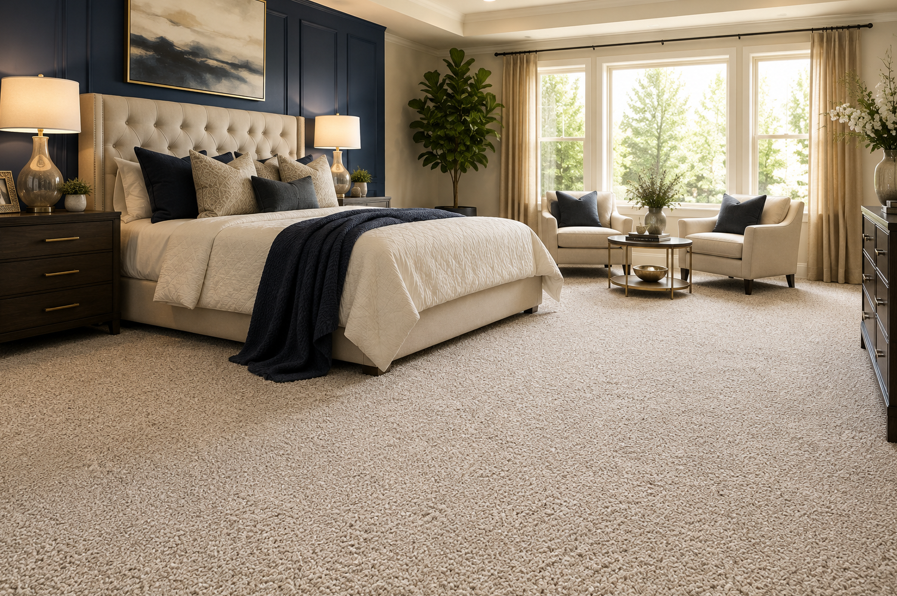
There is something immediately inviting about a soft cut-pile carpet. For bedrooms, lounges, upstairs living areas, and quiet family spaces, it can create the comfort many homeowners associate with a luxury interior.
The trick is choosing the right texture.
Look for Controlled, Dense Texture
A dense textured cut pile can give you softness without the perfectly groomed appearance expected from a formal velvet plush.
Small variations in the fibers help reduce the visibility of:
Footprints
Vacuum tracks
Minor changes in pile direction
Everyday traffic patterns
That makes the floor feel more relaxed while still looking refined.
Moderate Pile Height Often Makes Sense
The deepest carpet is not automatically the most luxurious.
An extremely long pile can require additional attention and may not suit rooms with substantial traffic. A medium pile with excellent density and fiber quality may provide a more polished balance of softness and practicality.
Think about how the room is used before choosing based entirely on how a sample feels in your hand.
Pay Attention to Twist
Twist refers to how tightly carpet fibers are twisted together in the yarn.
Rather than focusing on a single number without context, ask your flooring professional how the yarn construction is designed to retain its appearance in your intended space.
A carpet intended for an active family room needs different performance characteristics from one going into a quiet guest bedroom.
Homeowners comparing premium styles can browse available carpet flooring and then narrow the options according to softness, texture, durability, and the room’s traffic level.
Patterned and Cut-and-Loop Carpet Adds Designer Style
If you want the flooring itself to contribute to the room’s design, patterned carpet is one of the strongest luxury options.
Cut-and-loop carpet combines cut yarns with looped yarns to create differences in height and texture. Those differences can produce subtle geometrics, linear motifs, organic patterns, or more sculptural designs.
CRI notes that cut-and-loop constructions can create a wide range of surface textures and that multi-color designs can help disguise soil and stains.
Why Subtle Patterns Work So Well
A small-scale pattern can make a room feel more tailored without demanding constant attention.
Consider:
Fine grids
Soft diamonds
Broken linear patterns
Tonal chevrons
Organic textures
Small-scale geometric motifs
Current 2026 luxury carpet collections are leaning into this type of dimensional design. Floor Covering Weekly highlights finely scaled grids, woven geometrics, subtle waveform patterns, textured loops, and understated dimensional constructions among current premium introductions.
Pattern Can Be More Forgiving Than a Flat Solid
One advantage of tonal pattern is that it breaks up the surface visually.
A perfectly solid pale carpet can make every footprint, fiber direction change, or small mark easier to notice. Subtle tonal variation gives the eye more to read, which can make everyday changes in the surface less prominent.
That does not replace regular cleaning. It simply means the carpet does not have to look freshly groomed every minute to maintain its overall appearance.
Where Patterned Carpet Works Especially Well
Pattern can be effective in:
Stairs
Hallways
Primary bedrooms
Home offices
Formal living rooms
Dressing rooms
Upstairs landings
Staircases are particularly good candidates because the flooring can act almost like an architectural feature while also handling one of the home’s most visible traffic paths.
What About Wool Carpet?
Wool remains one of the traditional benchmarks for luxury carpet.
It offers a naturally rich texture and is associated with premium residential interiors. The Carpet and Rug Institute identifies wool as one of the principal carpet fibers and describes it as durable and resilient.
Current luxury collections also continue to use wool in high-end designs. Floor Covering Weekly’s 2026 coverage includes premium wool products positioned around durability, style, and luxury.
However, wool deserves a realistic discussion in an article focused on lower maintenance.
Wool Can Be Beautiful, but Check the Care Requirements
If easy everyday upkeep is your highest priority, compare wool carefully with premium synthetic alternatives.
Specific wool carpets can have different:
Cleaning requirements
Spot-treatment restrictions
Warranty conditions
Moisture considerations
Recommended cleaning products
A homeowner who loves natural materials and is comfortable following the manufacturer’s care requirements may still consider wool an excellent fit.
Someone whose first concern is handling children, pets, frequent entertaining, and unpredictable spills may find a premium performance synthetic more convenient.
Neither option is universally better. Luxury flooring works best when it fits the household rather than an idealized showroom lifestyle.
Choose Colors That Look Luxurious Without Showing Every Mark
Color has an enormous influence on perceived maintenance.
Very dark and very light carpets can both be visually demanding. A dark solid may show lint and light debris, while a pale uniform carpet may make spills and soil more apparent.
Mid-Tone Neutrals Are Easy to Live With
For many Eastside homes, sophisticated mid-tone neutrals create an effective balance.
Think:
Warm greige
Taupe
Mushroom
Soft brown
Natural beige
Muted stone
Heathered charcoal
These colors can work with a wide range of woods, furniture, cabinetry, and wall colors.
Heathered and Multi-Tonal Surfaces Add Depth
Rather than choosing one perfectly uniform shade, look at carpets with subtle color variation.
A heathered carpet can have two or more closely related tones mixed through the yarn. From a distance, the floor still reads as neutral, but up close it has more depth.
That visual variation can feel more luxurious while also being forgiving during everyday use.
Consider Bellevue and Kirkland Lighting Conditions
Lighting changes carpet dramatically.
Large windows can pull out undertones that are hard to see under showroom lighting. A warm beige may appear more golden in direct afternoon sun, while a greige could look cooler on a dark Pacific Northwest morning.
Place samples next to:
Wall paint
Upholstery
Wood furniture
Hardwood or LVP transitions
Built-in cabinetry
Drapery
Area rugs you plan to keep
Check them at different times of day before making the final decision.
Match the Carpet Style to the Room
One luxury carpet does not need to cover every carpeted room in the home.
Choosing construction by room can create a better mix of comfort, appearance, and maintenance.
Primary Bedrooms
Bedrooms are ideal locations for softer, more luxurious textures because they usually receive less concentrated foot traffic than hallways or stairs.
A dense textured cut pile can add softness without requiring the perfectly smooth appearance of formal plush.
Stairs
Stairs benefit from durable construction and a pattern or texture that retains a polished appearance under frequent use.
Low-profile patterned carpet can also highlight the architecture without making the staircase visually heavy.
Family Rooms
A family room benefits from a performance-oriented fiber, dense construction, and a surface that does not reveal every footprint.
If the room is used daily, durability deserves as much weight as softness.
Home Offices
A low-to-medium pile can create a comfortable, quiet work environment while making furniture placement and vacuuming easier.
Subtle woven or geometric patterns can also give an office a tailored, professional feel.
Guest Rooms
A guest bedroom can accommodate a softer, more formal carpet because daily traffic is usually lower.
This is one place where a homeowner can lean further toward plushness if the look fits the rest of the home.
Low Maintenance Still Requires a Good Carpet-Care Routine
No luxury carpet is maintenance-free.
The advantage of choosing the right construction is that normal care can be more manageable and the surface can remain attractive between cleanings.
Vacuum Before Soil Becomes Embedded
Regular vacuuming removes dry soil before it works farther into the carpet.
The Carpet and Rug Institute recommends establishing a consistent vacuuming routine, with more frequent cleaning in high-traffic and pet areas.
Use a vacuum that is suitable for the specific carpet construction. Some premium carpets have manufacturer recommendations regarding brush height, suction, or vacuum style.
Treat Spills Promptly
Blot spills rather than aggressively rubbing the fibers.
CRI recommends acting quickly, using appropriate spot-removal products, testing cleaning solutions in an inconspicuous area, and following proper rinsing procedures so residues do not attract additional soil.
More product is not necessarily better when cleaning carpet.
Always follow the flooring manufacturer’s instructions before using household cleaners or stain treatments.
Keep Outdoor Soil Near the Entrance
Simple habits reduce the amount of maintenance needed deeper inside the home.
Use quality entry mats, remove wet or heavily soiled footwear when practical, and pay extra attention to entrances during rainy Eastside weather.
Plan for Periodic Professional Cleaning
Routine vacuuming handles everyday dry soil, but deeper cleaning is still part of long-term carpet care.
CRI recommends professional deep cleaning approximately every 12 to 18 months while noting that homeowners need to check the specific warranty requirements for their carpet.
Following the product warranty and manufacturer care instructions is particularly important with premium flooring.
How to Choose a Luxury Carpet You Will Still Love Years From Now
Luxury carpet works best when it combines design with realistic expectations.
Instead of starting with "What is the softest carpet?", ask a broader set of questions:
Where will the carpet be installed?
How much traffic does the room receive?
Are children or pets using the space?
Do footprints and vacuum marks bother you?
Is stain resistance a priority?
Do you want a solid or patterned surface?
How much softness do you want underfoot?
What level of routine maintenance feels realistic?
What cleaning products does the manufacturer recommend?
What does the warranty require?
Which cushion works with the chosen carpet?
These questions can quickly separate a carpet that only looks luxurious on a sample rack from one that will actually work well in your home.
It also helps to view samples where the carpet will be installed.
Eastside Carpets & Floors offers both a Redmond showroom and a mobile showroom. The shop-at-home service gives customers an opportunity to compare flooring under their own lighting and alongside their existing furniture, wall colors, and finishes. Eastside Carpets & Floors notes that these surrounding elements can noticeably change how a flooring sample appears.
That is particularly useful when selecting premium carpet because subtle differences in texture and undertone often determine whether a room feels coordinated.
Homeowners in Bellevue, Kirkland, Redmond, Sammamish, Issaquah, Bothell, and Woodinville do not have to choose between a beautiful carpet and a practical home. Premium nylon, sophisticated textured cuts, subtle cut-and-loop patterns, performance-focused constructions, and thoughtfully chosen colors can deliver an elevated look without demanding constant attention.
If you would like personalized help finding carpet that balances softness, style, durability, and everyday care, get in touch with the Eastside Carpets & Floors team.


